
There was some part of me that hoped that Talespinner was a revamped, non-emulated rendition of Disney’s Tailspin so I could blast out a chorus or two of Oh-ee-yeah (Tailspin). Alas, it’s bloody Japanese folklore again in this yokai-infused deckbuilding yarn. In reality, though, I’d much rather play this as the original Tailspin game was too hard, and to be fair, I only liked it because it had Baloo in it and a catchy theme tune.
Flash Cat Games are probably wondering why the heck we’re not talking about their game and instead walking the gravel path that is 90s cartoons, so let’s not let their coffee get cold and get straight to it. Conceptually, it’s decent. On first playthroughs, it’s the same as any other deckbuilding experience, albeit the lovely visuals.
Talespinner needs to stand out from all the other games in the pool, and initially that’s the Japanese folklore aspect. This isn’t new to gaming, as everyone is a secret samurai of sorts with a fair bit of understanding of what a kasa-obake is, but this idea isn’t solely on the surface, as the ‘tale’ in the title is about weaving your own stories. With Japanese mythology and its narrative-driven appeal, I was surprised to find the storytelling quite lacking.
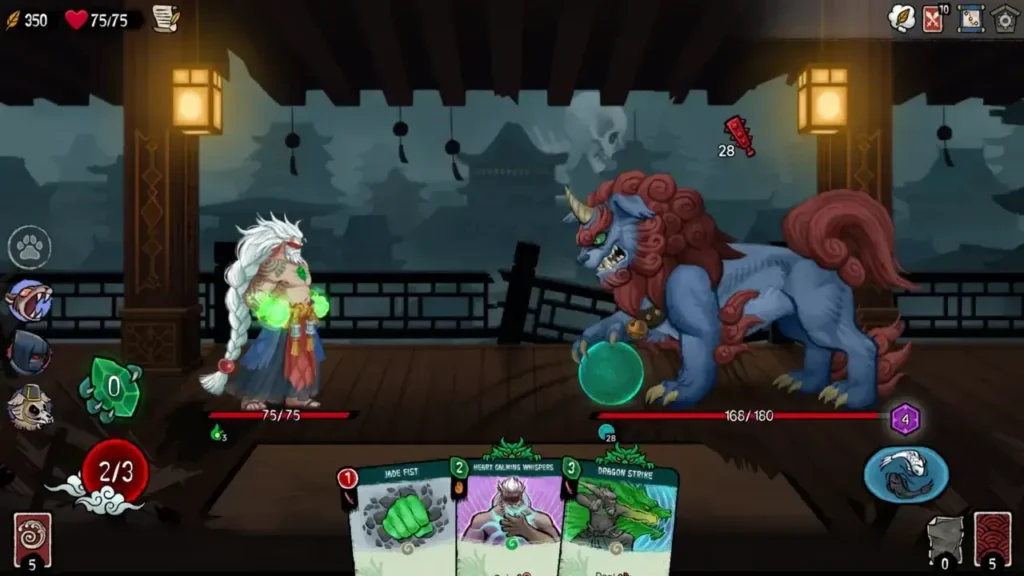
Like any other game of its ilk, the mechanics are straightforward. You have your attack and your defence cards, and everything is turn-based, with action points available dictating what card you play and how many options are available. The complexity/variety trickles in when companions are introduced that serve as active and passive buffs. A good deal are just ok, but there are some real bangers in there – notably anything that does extra damage or health restoration.
What I found to be the initial hurdle was the three characters available and determining which was right for me. My gut told me to go with the muscular monk, but instead opted for the token female magic dealer, Rinka. I skimmed over the explanations that modded cards with lotus leaves, making them more potent, and got complacent with her playstyle. Rather than go back to Gyokushin, the monk, I chose Himura, a.k.a. Pete and his dragon.
This was when Talespinner started to gain momentum. Himura’s cards had the same (mostly) effects as Rinka’s, but they were tailored to his style of play, which was a teamwork structure with the dragon. In short, you can determine their formation, with the dragon taking hits on your behalf. While you run the risk of ending a run if either character dies, I found myself playing exclusively with Himura for some time; getting to explore the various biomes and beautifully illustrated yokai.
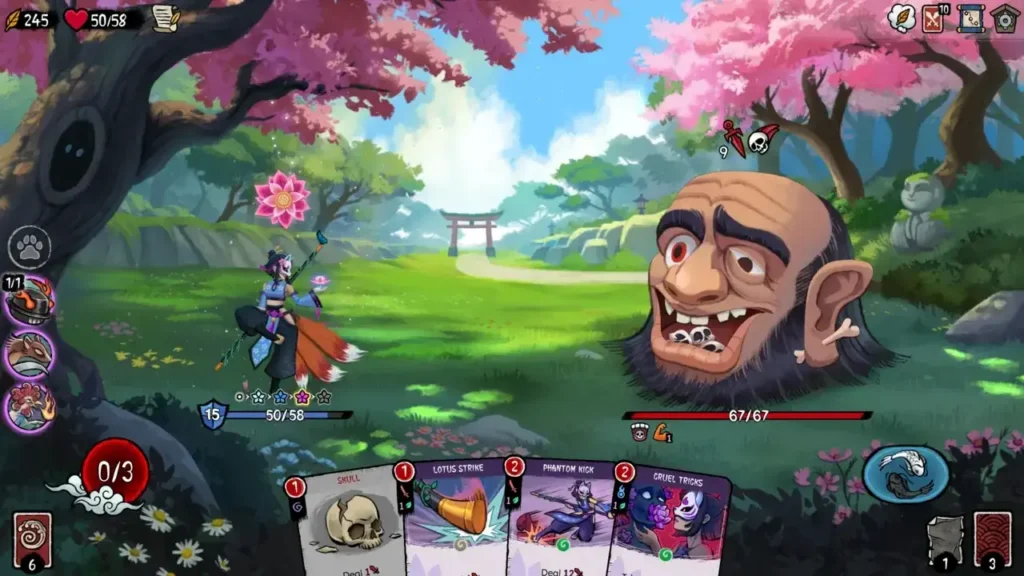
Talespinner will initially appeal to Japanophiles and those with a penchant for pretty things, but in terms of gameplay, it doesn’t completely reinvent the wheel for a deck-building rogue-like. However, that’s not a bad thing, especially if you can’t get enough of the genre/sub-genre – whatever the label may be. What sets it apart from the very decent character designs is the storytelling arc, though it wasn’t what I perhaps had expected.
There are no cutscenes or lengthy narrative walls, and instead, the game moves at a swift pace. Except for boss battles, which are challenging in the good sense. They aren’t Final Fantasy ‘I haven’t washed yet’ battles, though lots of hanging-by-a-thread moments and this was really entertaining, adding to the rogue-like loop. Instead, you earn story points after battles which can be used to determine your path.
Unlike other titles where you pick a path from a general world map, there are chapters to each arc where you can choose two ‘free’ events and pay for the others with your points. There are basic battles, random encounters, and opportunities to camp and restore some health. Additionally, there are elite battles, which are higher risks with higher rewards. Paired off with some guaranteed modifiers such as earning companions on a particular chapter, you can have a pretty decent strategy that offers a good degree of success.
Naturally, you’ll have a go-to character, and mine was Himura. I tend to go with tanky types that are hard-hitters and seldom go the mage route, with the odd Elden Ring exception to the rule. Himura was a decent balance of attack and defence, meaning that battles may last a little longer; however, it also meant I could too. In the process, this allowed me to level up my character, upgrade cards, and have a better chance of exploring Japanese folklore, loosely on my terms. And, as patience is a virtue, it just gets better and better the more you invest in your character/style of play.