
If you read the PEPPERED review, you’ll have noted my review approach of not having much in the way of expectations, with the aim that my response is often neutral and, ideally, authentic. Regrettably, I was really looking forward to Dunebound Tactics and had some undelivered expectations.
That ‘regrettably’ is the attachment I put on it being the spiritual successor to Dune 2. Nobody declared that, but from a glance at the images, keywords and the general vibes, I was hopeful of an RTS that would fill that gaping void from the days of the Amiga.
That is in no way a poor reflection on developers Terahard. They never said Dunebound Tactics was made for me. It’s like getting into a new car and assuming there’d be a swimming pool. Where was that on the specifications?
Tail firmly between my legs, I sucked it up and took on the sights. Ah… this is a tiny bit like Sunless Sea but in the desert, and without the weird stuff. As a fan of sand-based locations, as well as sandwiches, I packed my bags and got the caravan started. Time to get some sand in the cracks.
Solo Survival Is Suicide
The first notable thing about Dunebound Tactics is the amount of sand. It’s full of the stuff, and your caravan weaves through the dunes as if it were sailing, or some slippery salamander named Samuel, slithering through the… err, sand. It’s a bit slow, but go figure.
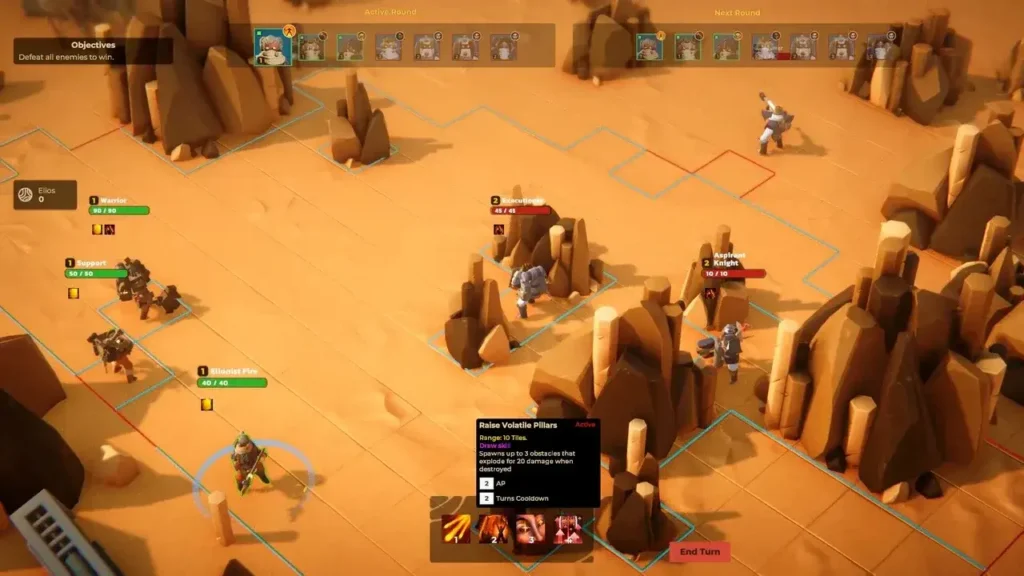
Living the nomad life is all about survival, so expecting to go on a wild exploration is naive, as you’re continually moving to the next spot of debris in the hope that you can rinse some resources, or recruit some folks to bolster your party, or sacrifice them for the greater good.
Decision-making in the game can be very selfish, as outside of the little dialogue exchanges loaded with a good selection of responses, you can head into one of the very many battles and boost your stats, or focus on your teammates. Initially, it’s only you, but strays can be invaluable.
As a party-based game, going solo is suicide, so these strays I mention are party members that can bolster your survival chances through a host of unique abilities and action points, or, as mentioned, they can be sacrificed, and you can extract their best bits to propel your quest for survival.
Here’s A Point. Or Two
Going back to the inevitable Dune reference, instead of spice, the currency in the game is Elios, which is used to power your caravan. No, not that type of caravan, but it also has sand in it. This can be earned through the quests set out in the game, and additionally through your crew.
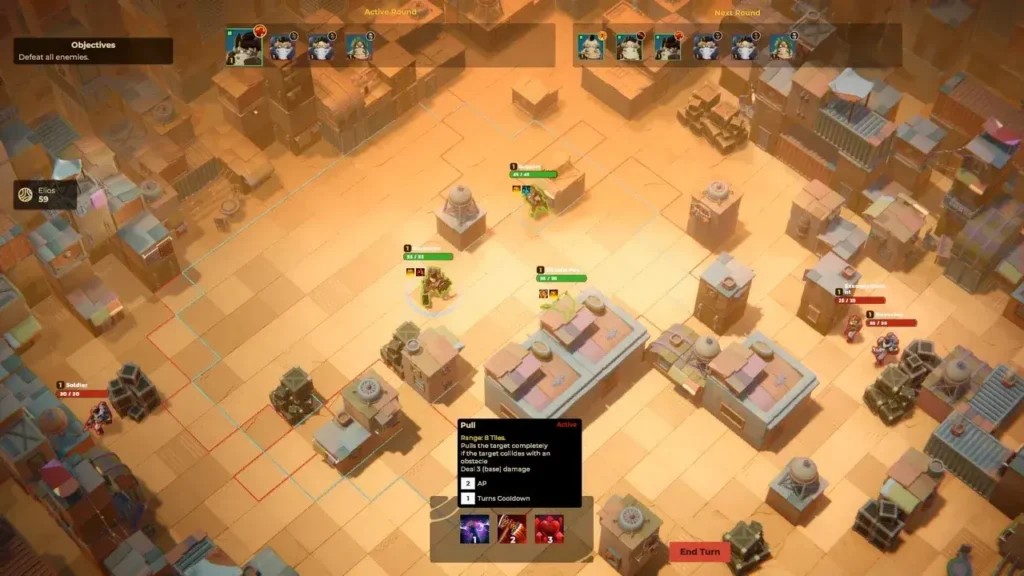
While the ship sailing in Dunebound Tactics is controlled by the player in real time, the core gameplay is a turn-based action one where you have to strategically place party members into specific roles to support one another, or foolishly wing it and rush them with sloppy attacks.
As you might surmise, you clever sausage, this decision-making process costs action points. The standard rhythm of things might be to move to a position to take cover and then attack an enemy, or vice versa, or position the most important members (you!) in a place of safety, using up both movement and attacks.
Healing is an option, of course, as well as those unique abilities where party members might steamroll through all cover with devastating attacks, or play a more supporting role by looking pretty until you decide to turn on them and extract some Elios out of them. You swine!
The Saving Grace
What is notably different about Dunebound Tactics, to say the least, compared to the quick example of Sunless Sea, Capes, or maybe Frostpunk, is how smooth the turn-based sections are. In some games I’ve played over the years, while methodical and part of the design, gameplay can be sluggish. Here, the enemies move pretty quickly, and the AI is decisive.
So decisive that I ended up dying quite early on. Being a people person, I didn’t see the benefits of stockpiling party members to be used as resources, thus putting myself forward in the line of fire. As a result, and not paying attention to my health, I managed to get myself killed and all of my followers.
Thankfully, all is not lost, as Dunebound Tactics is a rogue-lite, so it’s designed to be that way, and aside from the contrasting speed of the caravan, it moves at a decent pace. The same can’t be said about the narrative, as this often gets sidelined for the immediate focus of survival and quest-based activities. In that sense, it becomes peripheral.
Presentation-wise, it’s all good and straightforward to pick up. However, the difficulty level and resource management prove quite challenging, as not only are you weighing up whether you should turn Jenkins into a husk, but with that newly acquired Elios, should you invest in your caravan or buy new gear? Decisions, decisions, and regrettably, it is a life-or-death scenario.
A smoothly tactical rogue-lite where every crew member’s worth more dead than alive. I just wish the story rode along for the journey.
Pros
- Turn-based sections move smoothly
- Ruthless resource (people!) management
- Engaging, yet tough combat
Cons
- Visually appealing, but same environments
- The main story takes a backseat
- Again, it’s pretty hard