
Akiba Lost Review – In Akihabara, People Just… Vanish
Disappearances in Akiba are six-sided - maybe more...

Outlining Akiba Lost genuinely stumped me. In my intimate gaze at a blank screen, I drank a coffee, polished off a packet of crisps, and listened to a black midi album in full. That’s the first paragraph, invisible editor.
Akiba Lost isn’t a hentai game, nor a strategic text adventure where you reroute JR line trains to Akihabara. It’s an FMV. Longtime readers know I’m a Japanophile (steady) who enjoys a good FMV, and this one is unlike any other.
You’re Daiki Shinjo, a game designer who hit gold with his debut and has been releasing duds ever since. Following a check-up with his GP, he decides to make a live-action game based on some unsolved disappearances. Thirteen years earlier, his younger sister Ruri vanished and was never found. Blaming himself, he cut ties with his family and buried himself in his work.
In this opus, coincidentally called Akiba Lost, Shinjo recruits six unknowns to represent Akiba’s subculture – including underground idols, maids and otaku – and invites his other sister, Aoi, who reluctantly agrees. Once production starts, however, the disappearances repeat, only with a new cast.
Read All About It
I expected an abundance of live-action scenes and QTEs. Instead, Akiba Lost opens with live footage and almost immediately shifts into visual novel territory: still frames of live actors and lots of text. Not walls of text, mind.
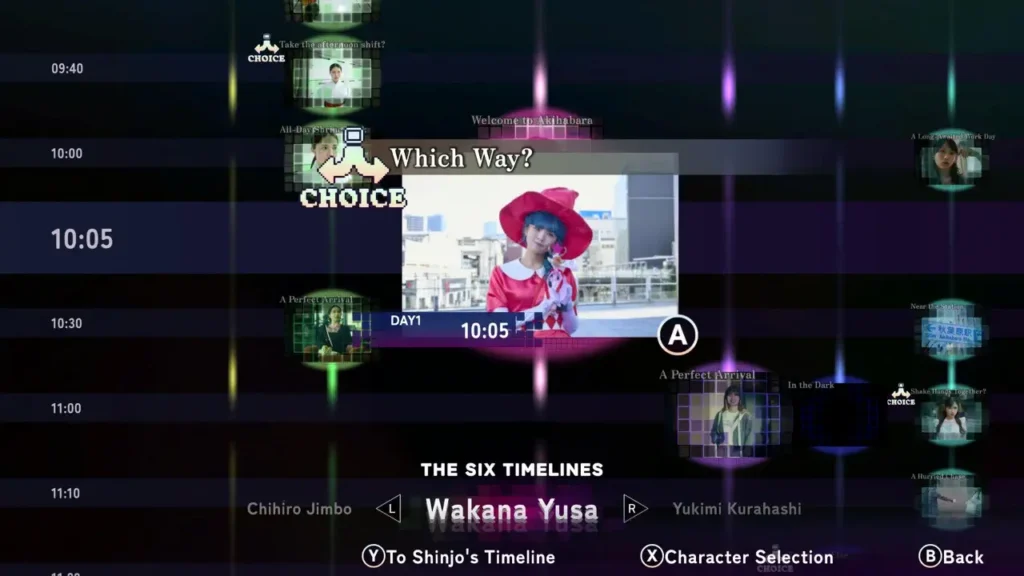
Sentences scatter across the screen rather than sitting in one dedicated box, and the dialogue is well-written and concise enough, at a decent pace. What breaks the rhythm is the intermittent bursts of images and pseudo-action sequences. At first it seems like it’s to do with budgets, then it becomes clear: this is a deliberate design choice for the multiple narrative threads and locations.
Six Characters, One Akihabara
You don’t stay solely with Shinjo. You play through a cast of characters across live-action sequences and stills, each section told from one person’s perspective – inner monologues, personal views of events that may or may not overlap with someone else’s. This could easily collapse into convolution. It doesn’t. It’s executed well, and it’s pretty damn cool.
For years I’ve had a script idea built on this approach, though it’s near-impossible in feature film. Akiba Lost proves the video game is the right medium for it. Which, interestingly, is also where it stumbles and could potentially make this even more niche.
Choices Have Teeth
As a narrative-driven adventurer, I love story, character development, and consequences. Choices matter here: pick wrong, and you can hit a game over in the first few minutes (as I did). That becomes clearer with other characters too, where it doesn’t seem like you have much scope for a positive path.
This can be off-putting. Other FMV titles like Five Hearts Under One Roof or the Sucker For Love series let you revisit the timeline and change your decision. Do that in an early chapter of Akiba Lost and everything after it resets.
It’s a risky decision, but also an excellent one. The caveat: you can’t always skip dialogue you’ve already read, despite a dedicated option to do so, because theoretically you haven’t experienced it yet. It adds serious weight to decision-making, and for that, I love it.
Clues, Codex, And Cold Characters
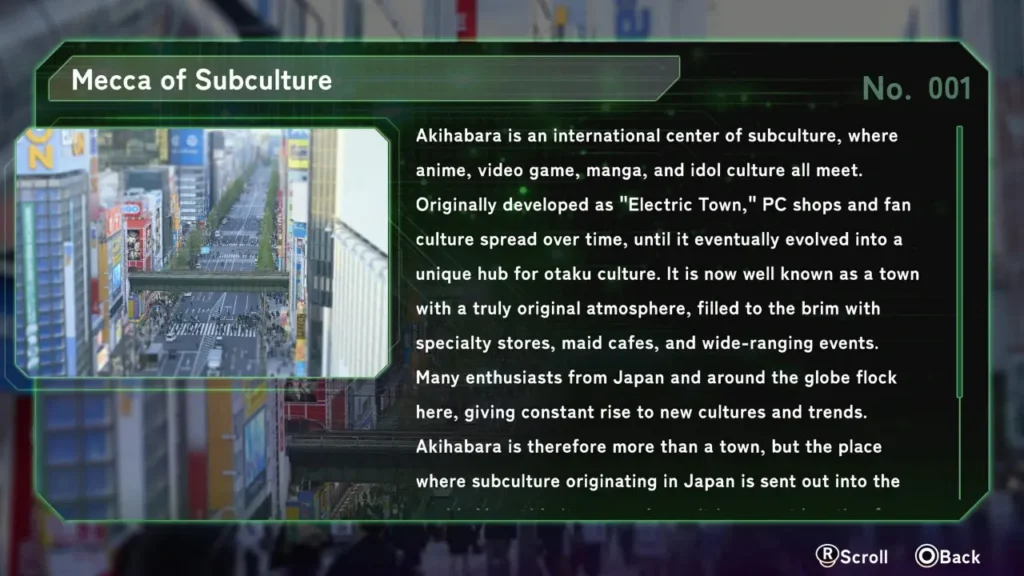
With the visual novel emphasis, there are plenty of clues to consume, building character profiles viewable from the pause menu. Some cover cultural points, which is interesting, while others are genuinely bizarre – the word ‘appointment’ turning up with a definition attached.
These aren’t Duck Detective-style keywords you drag into conclusions; it’s codex-building with no real function other than world-building, but it distracts from the gameplay. On the flip side, each one unlocks extras. Whether you read them thoroughly is up to you.
Some detective prowess is required, though. Character paths interlink in Akiba Lost, and you may need to finish someone else’s task first. Some characters sit literally frozen until you complete the steps to, erm, thaw them out. Then Shinjo returns to clean up loose threads – of which there are many.
Big Screen Required
Akiba Lost is huge. I first tried it on DroidDeck, which doesn’t handle FMV well at the time of writing. On the AYN Thor via GameNative, I cranked the performance and fan settings after one crash, and it ran well enough that I got through a lot of the story. While I’m a new advocate of handheld gaming, you need the big screen here because of the high production values.
Japanese film was my speciality, and I’m a fan of its cinematic history, less so its TV. Akiba Lost leans on cinema rather than its Nippon TV links, which surely helped secure excellent production values and decent actors. Technically it’s very good, and so is the story. The creators gambled on something ambitious and pulled it off.
Who Is This Actually For?
That said, I’m not entirely sure who the audience is. Japanophiles? Fine, but then the glossary feels surplus. Casuals? Possibly not. It’s also big for a typical visual novel (more visually than textually), and the FMV format doesn’t always behave how we expect. For that, I praise IzanagiGames (and the Sun), though it makes the target audience tricky to pin down.
A bold, multi-perspective FMV experiment that demands commitment but rewards patience.
Pros
- Varying perspectives executed with confidence
- Choices carry genuine weight
- Superb production values and strong acting
Cons
- Glossary entries often feel pointless
- The text sometimes takes over the screen
- Early endings are off-putting

No Comment! Be the first one.