
Sucker For Love: Date to Die For Review – A Cult Classic To Give You The Horn
Sneak past the cult, smooch the goddess.

Pre-emptive groan: I’m a sucker for Akabaka, as we have another entry in the series: Sucker For Love: Date to Die For. Completely out of sync with the order of their releases, the developer kindly provided codes for this, and in fear of being accused of any sort of bias, all these words are my own. The goat’s head? That was a gift. From a friend. You don’t know them.
While a simp to Lovecraftian adventures and actually warming to goddesses with tentacles on their mugs, from the screenshots, I’d thought that this would be the weaker of the three, as the main deity seemed a bit forgettable. Again, from the screenshots.
Admittedly, I would say that I still prefer the other two, yet I still have to give a recommended stamp up front. Sucker For Love: Date to Die For is really good, and the most challenging of the trilogy, not for unlocking the ‘true’ paths like the other titles, but because the mechanics are riskier.
You play as Stardust, a name their parents gave them. It’s their parents who are the catalyst, as they send her a letter to return to their home in Sacremencho (great play on words – English and Japanese!), only they disappeared a while ago. Who sent it? We might never know, but the destination is certainly memorable.
Welcome Home to the Goat God
Arriving back home, Stardust is immediately greeted by a cult called The Thousand Young who worship a goat-like deity named Rhok’zan, who now apparently resides in Stardust’s childhood home and potentially the object of their affection. Or lust, at least.
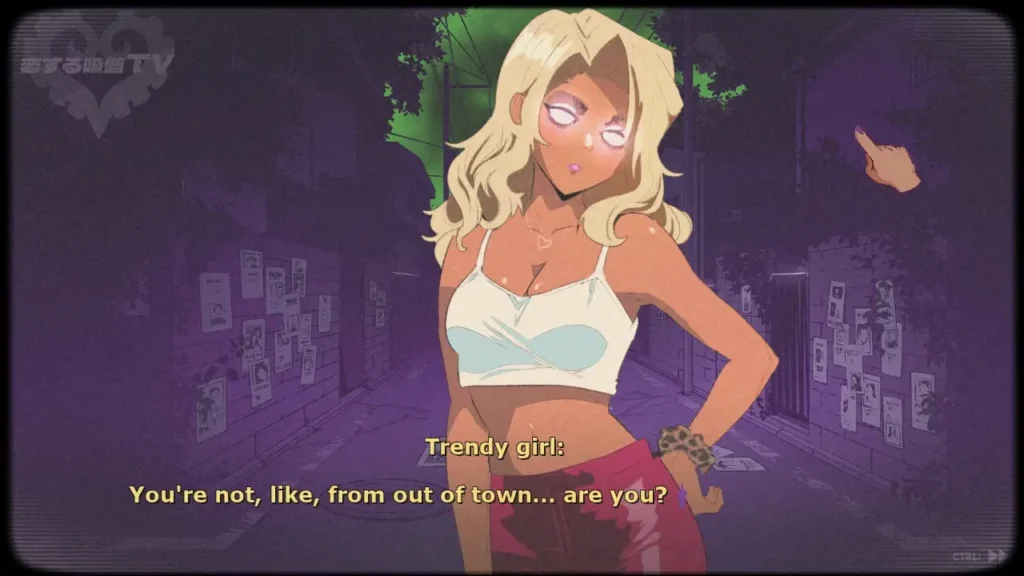
I’m no expert on Lovecraft in the slightest, though I am a bit of a purist and not particularly drawn to ‘reimaginings’ or ‘from the Lovecraft universe’. I almost bought a book thinking it was a Lovecraft anthology I hadn’t seen, only to see it was like buying a Guns ‘N Roses album with all the songs you know, but by unknown artists. True story, back in the day.
Was the above necessary? Not really, but for context, I hadn’t put two and two together to realise that the goddess here is actually a Lovecraft reference named Shub-Niggurath. Though H.P. never really wrote much about her. Akabaka haven’t created her for the sake of Sucker For Love: Date to Die For, but as with all these… antagonists, they’re incredibly likeable and, can I say, believable?
That’s testament to the voice actors, and once again, the excellent art style. What I’ve noted with the series is that it isn’t a reshash of the one before it. Each game features a familiar premise with varying gameplay mechanics, with some new ones and some removed.
Exploring the Haunted Childhood Home
With Sucker For Love: Date to Die For, there are some notable differences. Like Sucker for Love: Crush Landing, there’s only one real love interest (no spoilers); the same chanting of a ritual exists as in Sucker for Love: First Date, but the playing field is much more expansive and not restricted to an apartment.
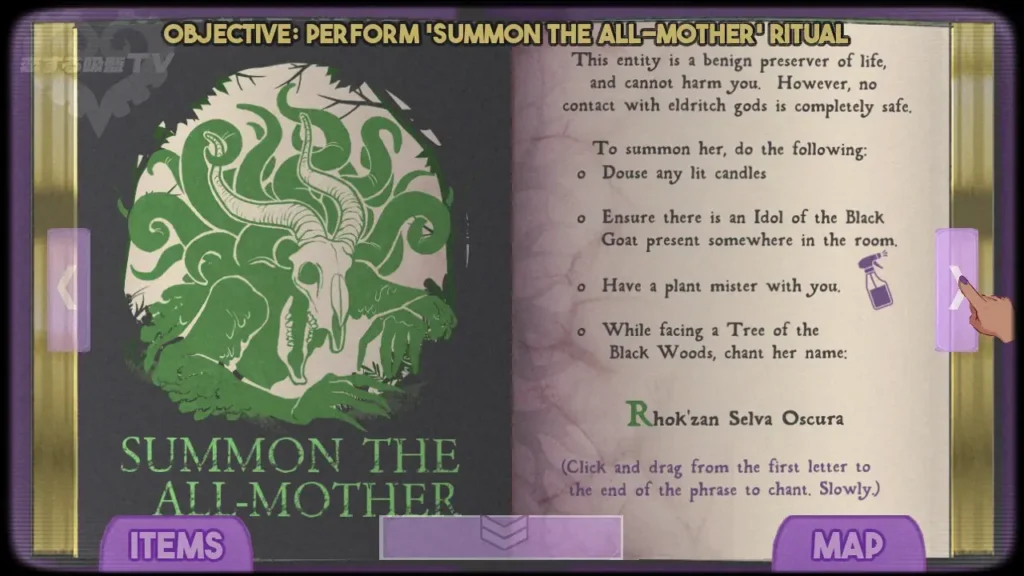
Ok, so it is effectively one structure you spend the vast majority of time in, but there are multiple rooms and floors as you explore Stardust’s childhood home. There are sliding doors and stairs to ascend, as well as a ladder, a map (due to the number of rooms), and lots more interactive moments with consequences.
The same applies in that you are completing steps from a ritual book, not for a date (as such), but to dispel a curse and help free Rhok’zan. Alas, the cult members are present within the home, and there are plenty of dangers they present, a.k.a. returning to a checkpoint.
One of the challenges includes locating ritual items throughout the house. Locating them is easy as they show up on the map, though the cult members patrol and, if they capture you, send you back to a checkpoint. There was one moment where I had to patiently wait for a character to reach my door and repeat this slow process two or three times.
Sliding Doors and Heart-Stopping Tension
As it’s another visual novel, the animations are minimal, so you’d think that avoiding enemies is easy. Once you know the paths, yes, it is, but first you have to proceed with caution. Those sliding doors play an important role as you slowly slide them back, see a cult member, then quickly close them and try elsewhere.
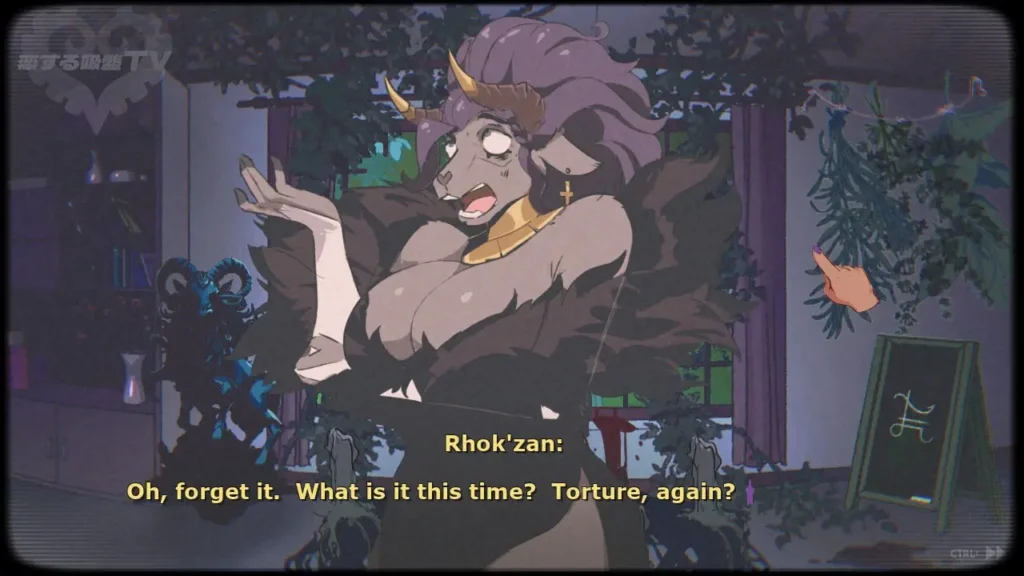
Alternatively, you can open the doors fast and die as I did, quite naively. While it was a mild annoyance having to repeat the steps (later realising the patterns and that it was easier than assumed), I really enjoyed the anticipation of someone behind a fusuma, even if it meant my heart skipped a beat or two.
Sucker For Love: Date to Die For’s puzzles are pretty straightforward, as the ritual book explains all you need, as well as the action required. There is some room for error, as a handful of events are time-limited and add to the attention.
This makes Sucker For Love: Date to Die For the most dynamic of the games and requires a bit more skill and patience, though again, it’s not going to be something to hold you back from thoroughly enjoying it.
The first chapter is relatively big, and you soon forget the format of the games, so when I managed to finish with the true ending(!), I was delighted that there was ‘another episode’, and secrets to unlock. So while Sucker For Love: Date to Die For wasn’t the one that initially appealed the most, it offers more depth and is essential to the collection.
A riskier, more expansive sequel that trades safe dating sim tropes for genuine tension, proving that sometimes the best way to woo a cosmic horror is to sneak past its cultists.
Pros
- Unique stealth mechanics in a visual novel
- Charming, distinct art style and voice acting
- Expansive exploration of the childhood home
Cons
- Rhok'zan doesn't have tentacles :3
- Not the strongest entry for pure romance fans
- Some time-limited events cause mild frustration
No Comment! Be the first one.