



Gambonanza Review: Here’s My Piece
For all budding masterminds: start playing chess by altering the rules.
Whoever thought up the idea for Gambonanza is a mastermind genius and should be observed like a hawk. What will they think of next? What’s their next move? Should I be worried about anything else I enjoy being modified with go-faster stripes and making it a bit more for modern audiences? All that fear is out of control, but until then, let’s all take a step back and admire what a great idea this is.
Chess + rogue-like aspects. Seems a bit silly. If it isn’t broke, don’t fix it. But… if it does work, why not mix it up a bit with something the kids on the street might want to play? On the contrary, the kids do like chess, and you’ll be really surprised that it doesn’t take much to get them involved. However, if you add some deck-building aspects, evil bosses, and a step-by-step approach to the rules, dat is de chess, innit? You end up with good results.
Think Chessarama mingling a bit with Slots & Daggers, and that’s the quick sum up of Gambonanza. You start the game with a scaled version of a chessboard, though with only three pieces to begin with. The same rules of chess apply, and I won’t be reviewing that, nor will I be explaining the offside rule. Essentially, it’s more or less the same thing as all pieces have the same moves and move restrictions, plus you can promote your pawns to another piece once you reach the other side of the board.
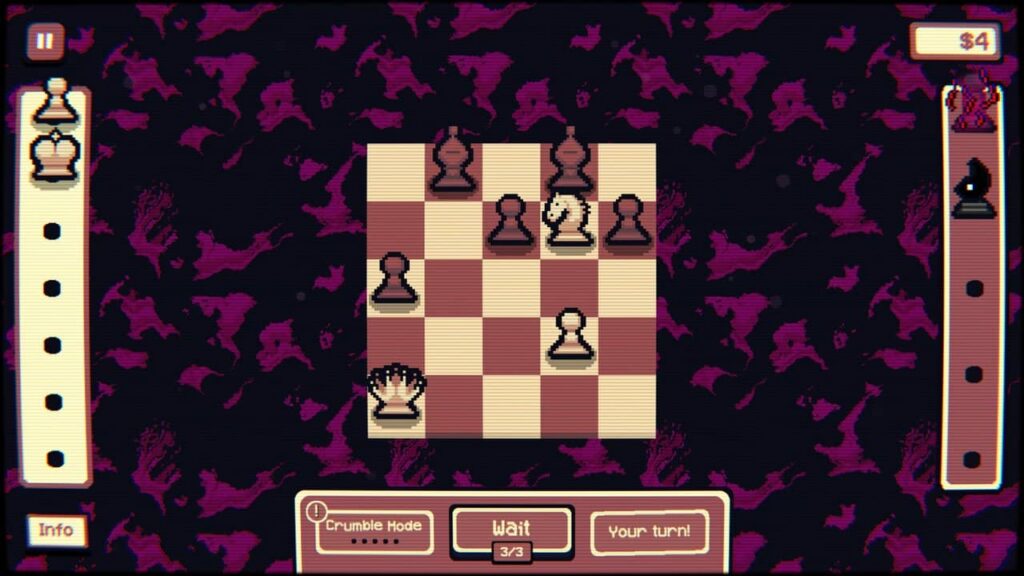
Here’s where it differs. The goal in Gambonanza is to take all the pieces, if you can, and you only have 5 moves to do it in, set over 5 stages at a time. Whoever has the most pieces wins. While the traits of all pieces remain the same (and there are tooltips and guides if you don’t know how to play chess, without it being complex), it’s the rewards after each stage that make it unique. Completing a round and taking pieces will award some cash that can be invested in a handful of things. There are Gambits: rule-bending abilities that award new pieces if you complete a particular task, or earn more cash per round, for example. There are also tokens that modify tiles, which may protect your pieces from capture or cause your opponent to miss a turn.
It’s only possible to have a limited number of Gambits at a time, so choose wisely. Additionally, new pieces can be earned and won, and these will show on the left side of the screen. Off-board pieces can be placed at any time, though you are initially limited to three pieces – as previously stated. To counter this, you need to invest some of your cash into expanding your available pieces. Naturally, if all your pieces are gone, it’s game over, and the run starts again, though there are a few olive branches, and you can get up to three retries on a stage.
Gambonanza is mostly random, what with it being a turn-based rogue-like, and at the start, you have a roulette spinner that decides on your starting pieces. This is also brought back later when you win pieces that haven’t yet been determined. Through progression, you stumble upon a cycle of bosses, each with their own traits. This can be casting a stasis spell on their pieces, making it impossible to capture them until you have waited three turns (available as a wait command, though being mindful that your enemy can still move during this time). Other times, the tiles will call down, or you’re unable to capture the key piece until defeating the others. It’s unique each time, and with the lure of 200-odd gambits and tokens to continually unlock, it’s very replayable.
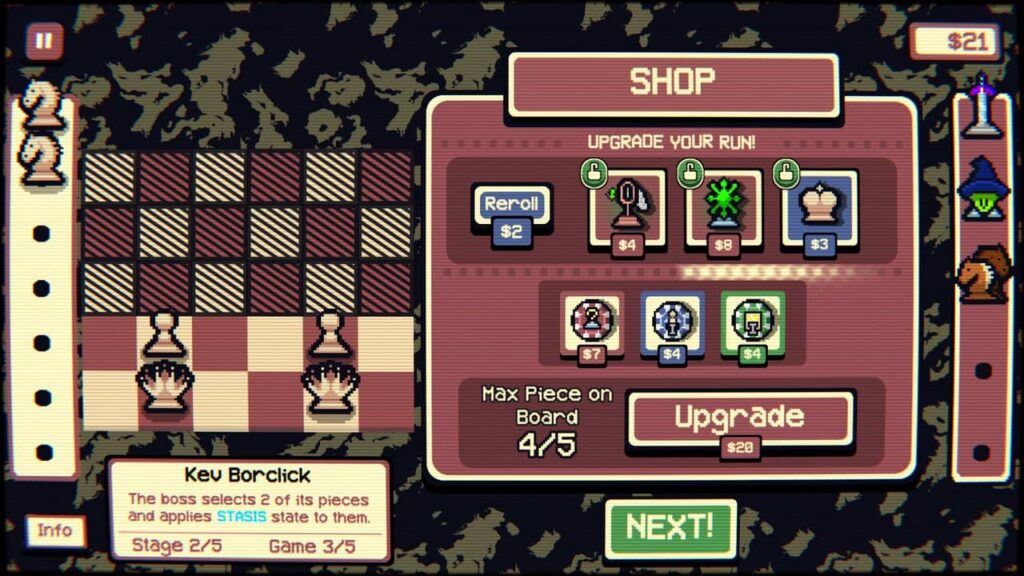
Also what’s so good about the level of accessibility is you aren’t bombarded with a full set to begin with. The game never feels stagnant, despite the odd stalemate, which is key in the game, due to all the Gambits, tokens and the unpredictability of the bosses. This makes it ‘fair’ to all, though even when you might not understand how to play chess, those tooltips can help. Even for veterans of the game, you’ll get little animations of your pieces sweating if they are at risk of being captured. Despite these early alerts, there’s more than enough scope to balls up and be somewhat erratic with your placement of pieces and get captured in quick succession, though that’s all down to human error, and once again, part of the game.
I really like Gambonanaza. Chess features periodically in my household, though we’re always about the physical game and online/gamified chess experiences aren’t quite the same. I’d be lying if I said this would replace, or even match, the classic experience, yet the quirky spin pays off, and the quick-fire games and variety of game-changing elements make this entertaining and well thought out, too. Remember, this is a game of strategy, and to have that aspect removed and do the equivalent of multi-ball in a football game and change up too much would be fatal. Instead, this is very much a thinking game, but it removes the stuffiness and seriousness of it all by adding a bit more excitement with aces, accessibility, and aardvarks. That, my friends, is an alliteration.